

What is PIEDAP Consent
What PIEDAP Consent does, what it leaves to you, who uses it and where it runs.
PIEDAP Consent asks people for their consent, records what they answered, and lets you prove it later. A business runs it on its own websites and apps. That business decides why and how the personal data is used.
One product, two names
The PIEDAP platform menu and the India site call it DPConsent. Both names mean the same product.
What it does#
- Shows the notice and asks. A banner and a preference centre show the wording you published, in the visitor's language, under the rules of the place they are in. In an iOS or Android app, your own screen shows that wording.
- Records every answer. Each answer is stored with the exact version of the wording the person saw, the time, the country and the law.
- Holds back tags. On a website, analytics and advertising tags wait until the visitor allows their purpose.
- Lets people change their mind. A visitor can reopen their choices and withdraw at any time. The withdrawal is recorded like the consent was.
- Keeps proof. Every change to a record is sealed, and each seal includes the one before. You can export a signed receipt for any record.
- Tracks rights requests. Requests for access, erasure, a grievance and others are logged with a deadline.
- Tells your other systems. A webhook, a signed message, goes to your server when someone consents, changes their choices, withdraws or is erased.
- Checks your set-up. It can scan your site for cookies and run a DPDP Act check on what it finds.
- Keeps a breach register. You record an incident, and it counts down the 72 hours for the detailed report to the Board.
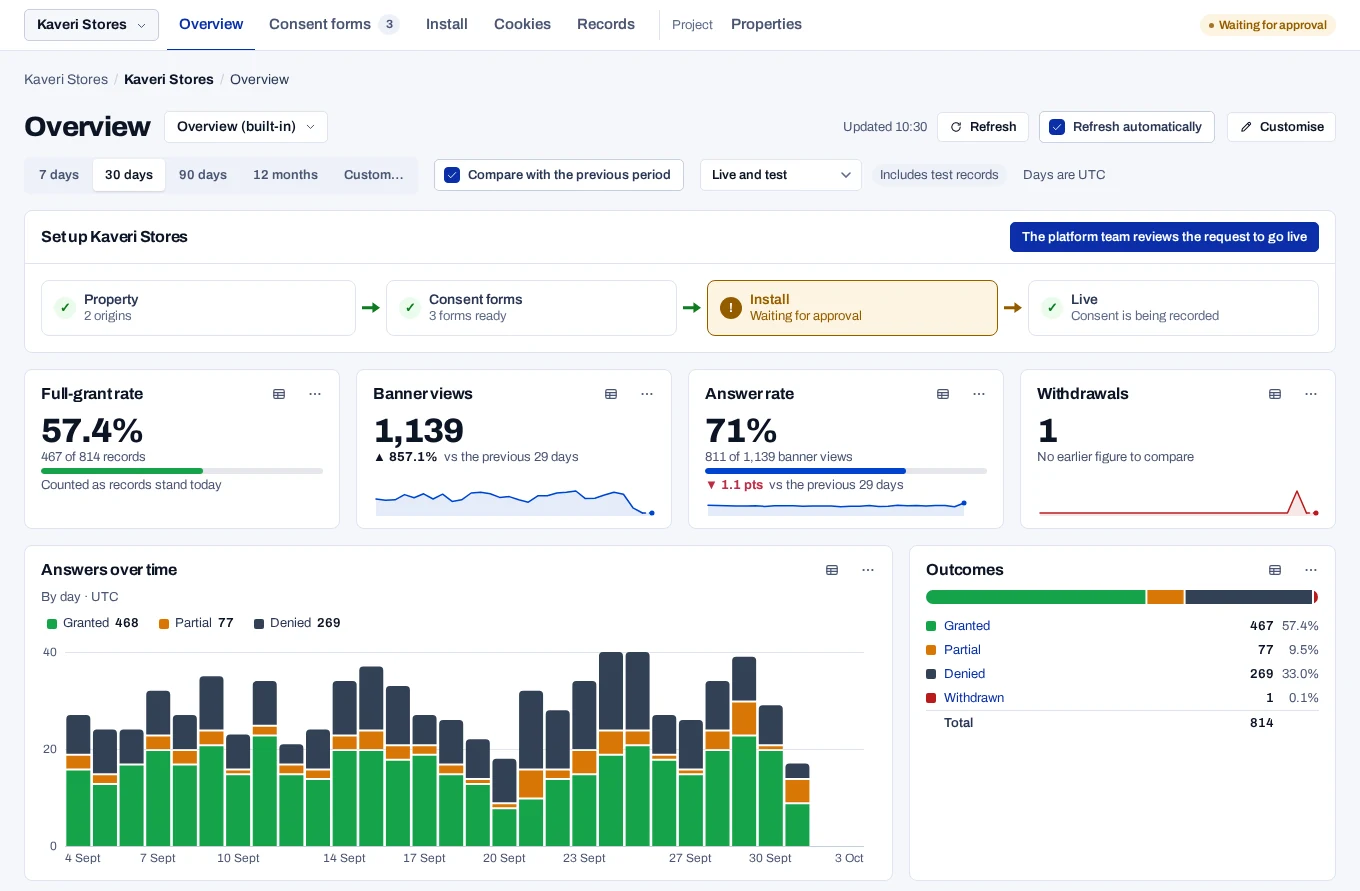
An example#
Kaveri Stores, a made-up retailer, publishes a notice for its shop website. Meera Iyer opens the shop, allows Analytics and declines Marketing. A consent record is created with her answers, the version of the notice she read, the country and the law.
Later Meera withdraws. A consent.withdrawn webhook reaches the Kaveri Stores server, which removes her from the marketing list. When a customer disputes a marketing message, the privacy lead opens the record and exports a signed receipt.
What stays with you#
PIEDAP Consent is a tool. You remain the business that answers for how personal data is used: the Data Fiduciary, in the words of India's DPDP Act.
The Act also describes a separate role, the Consent Manager. That is a company registered with the Data Protection Board that gives people one place to manage their consents across many businesses. Registration for that role opens on 13 November 2026. PIEDAP Consent does not act as a Consent Manager. Your own business uses it to give notice, collect consent and keep proof.
| The product does not | What you do |
|---|---|
| Give legal advice | Decide your purposes, the legal basis for each and the wording, with your own counsel. |
| Send email or SMS to your customers | Send confirmation links, breach notices and erasure warnings yourself. The product gives you the link, the draft text or the date. |
| Stop processing in your other systems | Call the consent check before you process, or act on the consent.withdrawn webhook in your customer database and email tool. |
| Erase data held in your other systems | Erase your own copy when the subject.erased webhook arrives. |
| Check a person's age or a parent's identity | Verify the parent or guardian yourself, then record the consent with how you verified it. |
| Correct personal data you hold | Track the correction request in the console and make the correction in your own systems. |
Who uses it#
| Person | What they use it for |
|---|---|
| Privacy lead or Data Protection Officer | Purposes, regions, publishing, evidence, rights requests and breaches |
| Marketing or content lead | The wording of the notice, its languages and its look |
| Developer | Installing the banner, holding back tags, connecting servers |
| Support agent | Finding a person's consent and answering their requests |
| IT or operations | Keys, webhooks and, on your own deployment, running the service |
Reading lists by role points each person to their pages.
Where it runs#
| Part | Where |
|---|---|
| The console | In your browser, at https://console.dpconsent.com or from the PIEDAP platform menu |
| The banner | In your visitors' browsers, loaded by one script tag |
| The mobile SDKs | In your iOS and Android apps, which show their own consent screen |
| Your servers | Node.js and Python packages, or the REST API, for recording and reading consent |
| The records | In the deployment, the running copy of the service, at https://console.dpconsent.com/consent |
Where the records are stored depends on your deployment. Ask your account contact which region yours runs in. To run the service on your own infrastructure, see Deploy with Docker Compose.
The product is not limited to India. A region rule decides which form each country sees and under which law. The same property, a site or an app, can serve a DPDP notice in India and a GDPR banner in Europe.